

Uncategorized
How Many Countries Are There in the World? Definition, Lists, and Who Decides
May
How Many Countries Are There in the World?
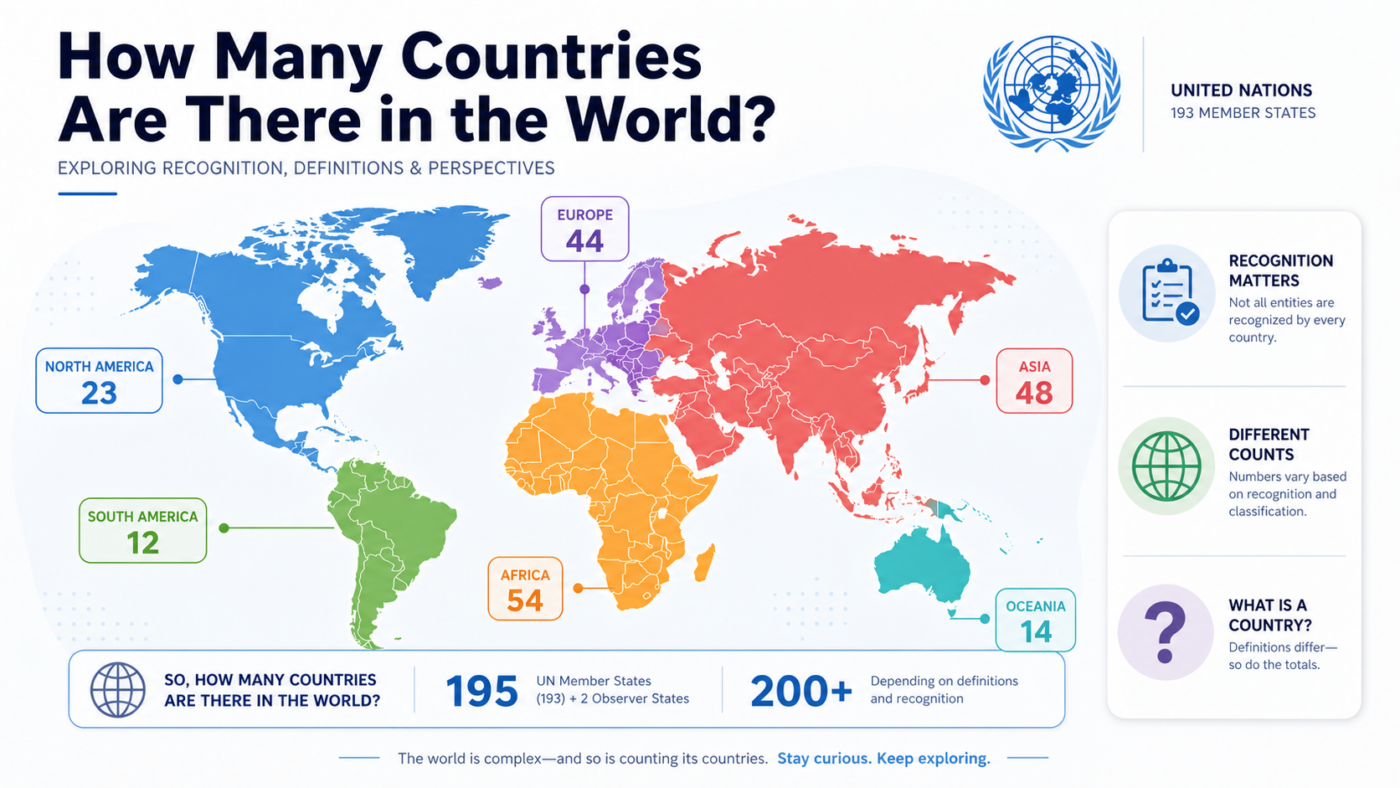
There is no single, universally agreed answer to the question “how many countries are there?” — but the most commonly cited figure today is 195, based on the United Nations system. For example, Worldometer , BBC Science Focus , and Encyclopaedia Britannica all explain this 195‑country figure.
To understand why that number is disputed, you have to look at how international law defines a “country,” who recognizes it, and which organizations decide to put it on their lists.
How Many Countries Are There?
The most widely used answer is:
- 193 UN member states
- 2 non‑member observer states: the Holy See (Vatican City) and the State of Palestine
That gives a total of 195 countries in the “UN sense,” a number you’ll see on sites such as Worldometer and World Population Review .
But other counts exist:
- Some writers argue for around 197 countries by adding a few widely recognized but non‑UN‑member states, as discussed in explanations like Britannica’s country overview .
- Travel‑oriented lists sometimes go above 200 “countries to visit” by including partially recognized states and territories; you can see this in travel‑focused breakdowns such as OneStep4Ward or The World Travel Guy .
- The CIA World Factbook and similar references list more than 230 “countries and other entities” by counting territories, dependencies, and special regions separately, which is reflected in summaries like World Population Review’s entity count .
So the honest answer is: the number of countries depends on which rules and which list you use.
Who Decides What Counts as a Country?
In international law, a “country” is usually discussed as a state — a sovereign political entity. Articles on political geography and international law (for example, The Geography Site , Rule of Law Education Centre , and the “Country” entry on Wikipedia ) describe two main ways of thinking about this.
1. The Montevideo Criteria (Declarative Theory)
The classic legal reference is the Montevideo Convention on the Rights and Duties of States (1933). It says that a state should have four basic characteristics:
- A permanent population
- A defined territory
- A government
- The capacity to enter into relations with other states (in practice, the ability to conduct foreign policy)
Under this declarative theory, a state exists if it meets these criteria, regardless of whether other states recognize it. This view is summarised in accessible form at The Geography Site’s “How Do You Define a Country?” and in legal explainer pieces like “Becoming a Country Under International Law” .
2. Recognition by Other States (Constitutive Theory)
The constitutive theory says a state is a person in international law only when other states recognize it. Put simply, it is hard to function as a “country” globally if no one treats you as one — no embassies, no treaties, and usually no seat in international organizations. Discussions of this approach appear in many introductions to international law and in summaries like the Rule of Law Education Centre explainer and Wikipedia’s overview of “Country” and “State” .
In practice, the real world blends both theories:
- Meeting the Montevideo criteria gives an entity a legal claim to statehood.
- Widespread recognition, especially by major powers and international bodies, gives it practical legitimacy.
This is why some places look and act like countries but are not universally counted in headline “how many countries?” totals.
The Role of the United Nations
The United Nations is not the only authority on what counts as a country, but it is the closest thing we have to a global reference point. Articles from Britannica and other educational sources explain how UN membership drives the standard 195‑country figure.
- The UN currently has 193 member states, each admitted by recommendation of the Security Council and approval of the General Assembly.
- It also recognizes two non‑member observer states: the Holy See and the State of Palestine.
Because nearly every government seeks UN membership, and because membership requires broad agreement among existing members, UN status is widely used as evidence that an entity is considered a “country” by most of the world.
Other organizations keep their own lists:
- FIFA (world football) has more members than the UN, counting some entities that are not UN member states.
- The CIA World Factbook distinguishes between independent states and “dependencies / other areas,” which is one reason its total entry count rises above simple country tallies, as reflected in summaries at World Population Review .
Each institution’s count reflects its own mission: diplomacy, sport, intelligence, statistics, or education.
Where to Find a List of Countries
The “right” list depends on what you need: schoolwork, business, travel, or political analysis.
1. UN‑Based Lists (the 195‑Country Perspective)
If you want a clear, conventional list aligned with UN recognition, good starting points include:
- Worldometer – How many countries are there in the world? — explains the 195‑country breakdown and links to an alphabetical list of countries .
- Encyclopaedia Britannica – How Many Countries Are There in the World? — discusses the 195 total and provides access to country profiles.
- World Population Review – How Many Countries Are There in the World? — offers a sortable table with country names, population, region, and UN membership details.
2. Lists That Include Territories and Special Cases
If you want to include territories, dependencies, and partially recognized states, you’ll need broader lists:
- The CIA World Factbook (summarised by sites like World Population Review ) catalogs independent countries plus “dependencies and other areas,” which is why its total number of entries is higher than 195.
- Travel and finance websites sometimes compile extended lists of 197 or more “countries,” such as OneStep4Ward’s country count , The World Travel Guy , or Global Banking & Finance’s list of countries .
3. Encyclopedias and Educational Resources
For context plus lists, you can also use:
- Britannica – List of Countries — an alphabetical country list with regional information.
- Educational articles such as “How Do You Define A Country?” on The Geography Site or explanatory blogs on current country counts , which combine numbers with explanations of why they differ.
Why There Is No Single “Correct” Number
So, how many countries are there in the world?
- If you mean “UN members plus observers,” the answer is 195 — a figure used by sources like Worldometer , BBC Science Focus , and Encyclopaedia Britannica .
- If you include every entity that behaves like a country or is treated as one in some contexts, the number can rise above 200, as travel bloggers and analysts discuss in posts on OneStep4Ward and The World Travel Guy .
- If you also count all territories, dependencies, and special regions as separate entries, you reach the 230+ “countries and other entities” level you see summarized in places like World Population Review .
The core issue is that “country” is not a purely mathematical category. It’s a mix of:
- Legal definitions (like the Montevideo criteria)
- Political recognition (which states are willing to acknowledge others)
- Institutional needs (how the UN, FIFA, the CIA, and others choose to structure their lists)
Once you understand that mix, you can read any “number of countries” claim more critically, and choose the list that best matches your purpose — whether that’s teaching geography, planning travel, or analyzing international politics.
Turn Country Facts Into an Interactive Quiz with NeoGeo
If you want to move beyond just reading about countries and actually interact with the map, try turning this topic into a quiz. With the NeoGeo Quiz WordPress plugin, you can upload your own GeoJSON world map, choose which field users must identify (like country names or codes), and embed a fully interactive “How many countries are there?” challenge directly on your site—perfect for classrooms, geography blogs, or anyone who wants readers to learn by clicking instead of just scrolling.
